
Question

Blueprints Software Update Settings deferral: older release disappears when a newer one ships

  • Nov 3, 2026 11:42 AM UTC
  • 3 replies
  • 31 views

paczo_xyz
Forum|alt.badge.img

Hi all,

I'm looking for the right way to get the old Restrictions profile deferral behavior in Blueprints on macOS 27

What I had before was

Restrictions profile with a 30 day deferral. Once the 30 days passed, the update became available, I set a Nudge, and the rollout went smoothly.

What I have now

Blueprint with Software Update Settings, deferral set to 30 days for major and 7 days for minor. Scope is a smart group of managed Macs (testers excluded). Around 90 Macs on macOS 26.x.

What happened:

- 27.0.1 was released on September 28. After the 30 days it became available and about 90 Macs updated.
- 27.2 was released on October 26.
- About 3 days ago people stopped updating. Nudge was telling them an update was due, but nothing could be installed. The newest version Software Update offered on those Macs was 26.7.2.
- I disabled Nudge and started checking. The only change on my side is the 27.2 release. Since then 27.0.1 is no longer offered, and 27.2 will not show up until November 25.

My current understanding is that the newest release takes over and gets its own 30 day clock, so the previous release is hidden even after its own deferral has ended. I have not found this documented anywhere, so it is partly a guess.

What I want…

Each release becomes available 30 days after its own release date, regardless of what Apple ships in between. For example, 28.5 is released, 30 days pass, 28.5 becomes available. The update stays optional, with a Nudge after the deferral and no forced install. A DDM enforcement declaration always has a deadline, so that is not what I'm after.

How are you handling it? Shorter deferral, or updating the Blueprint every release?

3 replies

justin_smith
Forum|alt.badge.img+8
  • New Contributor
  • Nov 3, 2026 2:23 PM UTC

Your understanding is right, and it's a limitation of deferral-only management, not a misconfiguration.


Deferral in Software Update Settings only controls when an update appears — 1 to 90 days after Apple releases it. That component doesn't start or enforce an update (Jamf's Blueprints guide says this explicitly). It also doesn't pin a version. When 27.2 shipped, it replaced 27.0.1 as the offer. One extra wrinkle in your case: for the Macs still on macOS 26, 27.2 isn't a minor update — it's the major upgrade — so it's your 30-day major deferral that applies to it, not the 7-day minor one.


That means the behavior you want — every release available 30 days after its own date, no matter what ships in between — can't be done with deferrals alone. Shortening the deferral only shrinks the gap; it doesn't preserve the older release.


What works for me is splitting the two jobs:


1. Keep the Software Update Settings deferral as a backstop, so nothing appears early by accident.

2. Drive the actual rollout with the separate Software Updates component in a Blueprint. That one enforces a target version with a deadline, and per Jamf's guide an enforcement declaration takes precedence over a deferral — the update becomes available even inside the deferral window.

3. Each release: test the new version on your test group by enforcing that specific version there, then set the same target version plus your deadline (for example, release date + 30 days) for the fleet group. Yes, that does mean updating the Blueprint every release — that's the trade for a tested, pinned rollout.

4. Point Nudge at the version you're actually enforcing. In the gap you hit, Nudge was chasing 27.0.1 after the offer had already moved on to 27.2, so users were prompted for an update that no longer existed for them.


For the Macs still behind: they won't get 27.0.1 back as the offered update. The realistic options are to wait out 27.2's deferral, or test 27.2 now (step 3 gets it to your testers immediately) and enforce it to the fleet once you're happy with it.


paczo_xyz
Forum|alt.badge.img
  • Author
  • New Contributor
  • Nov 3, 2026 2:36 PM UTC

Thanks, that worked. With a Software Updates declaration pinned to 27.0.1, it shows up in Software Update right away, even with 27.2 out.
 

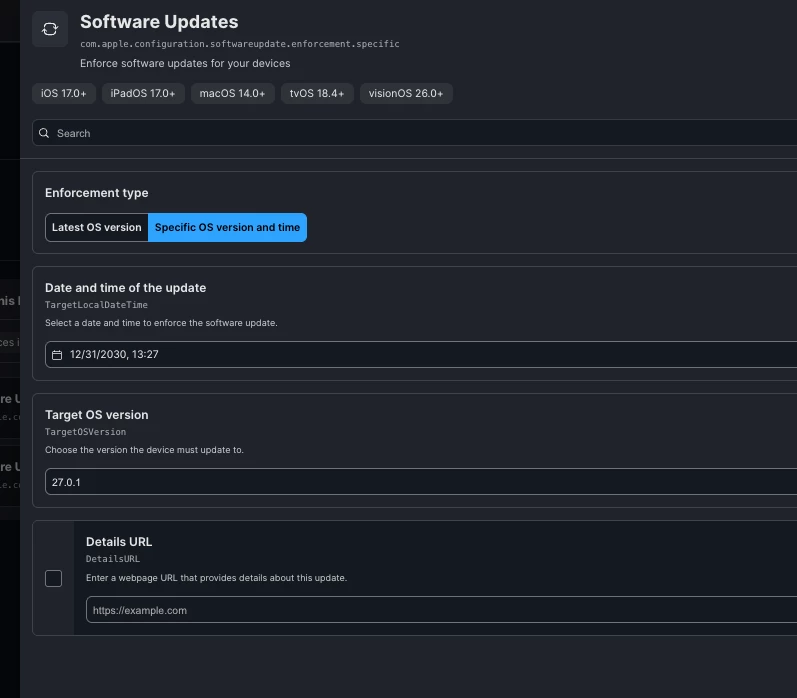
One thing.. I don't want to force anything. Is there a way to have no due date at all? Right now I'm setting the enforcement date to the end of December 2030, but the Mac tells the user "Your organisation requires an update". Would you just put a date far in the future (like i did) and let Nudge handle the real deadline? Or is there a cleaner way?


justin_smith
Forum|alt.badge.img+8
  • New Contributor
  • Nov 3, 2026 4:36 PM UTC

Worth naming the premise problem here: an enforcement declaration with no due date isn't a configuration that exists.


TargetLocalDateTime isn't an optional extra on enforcement.specific — the due date is what the declaration is. Its entire purpose is compelling the update by a deadline, so the "Your organisation requires an update" message isn't a side effect you can switch off while keeping the declaration. It's the mechanism working. The moment the declaration is active and the device is below target, the OS announces a requirement, because announcing requirements is the job.


The far-future date doesn't neutralise it either — it just defers it, and leaves a live order in place: in December 2030 that blueprint would demand macOS 27.0.1, a five-year-old OS, from anything still carrying it. Forgotten declarations are how fleets end up with mystery behaviour years later.


And "no due date at all, let Nudge handle the real deadline" cuts against itself — Nudge is a due-date tool. A required install date with escalating prompts is its whole design.


If what you want is availability without compulsion, that's a legitimate goal — it just isn't this tool. Don't deploy the enforcement declaration at all. Keep 27.2 hidden with deferral so 27.0.1 is the only offer on the table, and users take it voluntarily — no org-required messaging, because nothing is being enforced. When you do want a real deadline, set exactly one: in Nudge, or in the declaration. Not a pretend one in 2030.